
Replacements, widening & aprons
Concrete Driveways in Gainesville, FL
A firm base, the right thickness and a slope that moves storm water off the drive.
- Free on-site measuring visit
- Written, itemized quote for every job
- Base, drainage and thickness spelled out before we pour
Driveways That Stay Level Through Storm Season
Concrete driveways in Gainesville rarely fail from the top down. They fail from below, when rain runs under the slab and moves the sand that holds it up. You see it as a panel near the garage that has dropped, a crack that keeps getting wider, or an apron at the street that has broken off. Many driveways in the city date from the 1970s and 1980s, when about 40 percent of Gainesville's homes were built according to Point2Homes' Census summary, and a lot of that concrete was poured thin on loose ground.
Signs it is time to replace
- Cracks wide enough to fit a coin, or cracks where one side sits higher
- A panel near the garage or house that has sunk and holds water
- Water that runs toward the garage door or the foundation
- A broken or crumbling apron at the street
- Roots lifting the edges
- A drive too narrow for the cars you have now
One sunken panel on an otherwise sound driveway can often be lifted or replaced on its own. When cracks, settling and broken edges show up together, a new driveway is usually the better spend.
What goes under the concrete
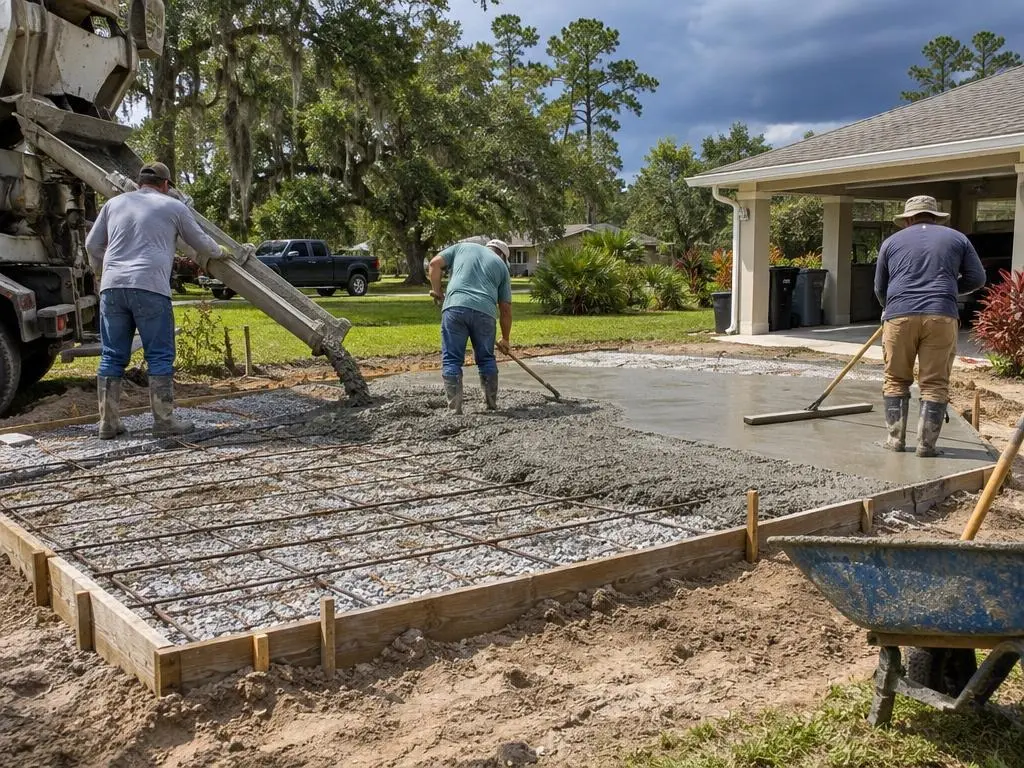
We break out the old driveway and haul it away. Then we dig out soft or organic soil, add fill where needed and compact the base in layers so it supports the slab evenly. Forms are set so the finished surface slopes away from the garage and the house and toward the street or yard.
Thickness depends on use. HomeGuide's driveway guide recommends at least 4 inches for ordinary cars, 5 to 6 inches for RVs or heavy vehicles, and thicker edges of 6 to 8 inches. If you park a boat, a trailer or a work truck, we thicken that area. Rebar or wire mesh helps hold cracked sections together, and control joints on a planned layout keep shrinkage cracks in straight lines.
Aprons and Gainesville's rules
The part of your driveway between the property line and the street sits in the public right-of-way, and the city has standards for it. Public Works memo EDCM 24-02 says driveways in the right-of-way are built of 6-inch-thick concrete and that the apron grade should not exceed 9 percent unless the City Engineer approves. Single-family homes on minor local streets may use the city's concrete flared driveway detail. The city's right-of-way page says driveway installation and inspection go through the Department of Sustainable Development at 352-334-5050. In unincorporated Alachua County, the county Public Works department handles right-of-way connections. We plan the apron to the rules for your address.
Finish choices
- Broom finish: the standard. It grips in the rain and costs the least.
- Exposed aggregate: the top paste is washed off to show the stone. It hides stains and tire marks.
- Stamped or colored borders: a decorative band along the edges with plain concrete in the lanes.
- Smooth finish: looks clean but gets slick when wet, so we keep it off sloped driveways.
After the pour
Walk on it after a day or two. HomeGuide says to wait at least 7 days before driving on a new driveway and about 30 days before parking heavy vehicles on it. Wait the full 28 to 30 day cure before the first coat of sealer, then reseal every 2 to 3 years. Keep downspouts pointed away from the slab and fix leaking hose bibs or irrigation lines near the edges, since steady water under concrete is what causes most settling here.
What the Driveway Quote Covers
Each item below is a separate line on your quote.
Tear-out and hauling
The old concrete, asphalt or pavers removed and hauled away.
Base preparation
Soft soil dug out, fill added where needed and compacted in layers.
Slope and forms
Forms set so water runs away from the house and garage.
Reinforcement
Rebar or wire mesh matched to the slab size and the vehicles it carries.
Pour, finish and joints
Concrete placed, broom finished and jointed on a planned layout.
Aprons and extensions
Street aprons built to city or county standards, plus widening and parking pads.
Typical Concrete Driveway Costs
| Item | Published range |
|---|---|
| Standard driveway, per sq ft installed | $6 to $10 |
| One-car, 12 x 24 ft | $1,700 to $4,300 |
| Two-car, 20 x 20 ft | $2,400 to $6,000 |
| Two-car, 24 x 24 ft | $3,500 to $8,600 |
| Three-car, 24 x 36 ft | $5,200 to $13,000 |
| Old driveway removal, per sq ft | $2 to $6 |
| Grading, per sq ft | $3 to $8 |
| Sealing, per sq ft | $1 to $3 |
Figures from HomeGuide's concrete driveway cost guide (national averages). Gainesville prices can run higher or lower, and size, access, removal and finish all change the total. Your written estimate after we measure is the price.
How It Works
1. Measure and quote
We measure, check drainage and the apron, then send a written quote.
2. Permit
We confirm the city or county permit for your address.
3. Tear-out and base
Old driveway removed, soft soil replaced and the base compacted.
4. Pour and cure
Forms, steel, concrete and joints, then written dates for driving and sealing.
Why Choose Us for Concrete Driveways
Sized for your vehicles
Extra thickness where trucks, boats or trailers park.
Apron built to code
Right-of-way work planned to the city or county standard.
Concrete Driveways Questions
How long does a concrete driveway last?
HomeGuide's driveway guide gives 30 to 40 years for a well-built, maintained concrete driveway. In Gainesville, a good base and good drainage are what push a driveway to the long end of that range.
How thick should my driveway be?
HomeGuide recommends at least 4 inches for cars and 5 to 6 inches for heavy vehicles. Inside the City of Gainesville, the part of the driveway in the right-of-way is built of 6-inch concrete under the city's design standards.
Can you pour over my old driveway?
We rarely recommend it. New concrete over a cracked, sunken driveway picks up the same cracks and settling, and it raises the surface at the garage and the street. Removing the old slab and fixing the base lasts longer.
Who issues driveway permits in Gainesville?
The city's Public Works page says driveway installation and inspections go through the Department of Sustainable Development, 352-334-5050. For homes outside the city, Alachua County Public Works handles right-of-way connection permits.
When can I park on it?
HomeGuide says to wait at least 7 days for cars and about 30 days for heavy vehicles. We give you exact dates.
Concrete Driveways Service Areas
- Concrete Contractors in Gainesville, FL
- Concrete Contractors in Alachua, FL
- Concrete Contractors in Newberry, FL
- Concrete Contractors in High Springs, FL
- Concrete Contractors in Archer, FL
- Concrete Contractors in Hawthorne, FL
- Concrete Contractors in Micanopy, FL
- Concrete Contractors in Waldo, FL
- Concrete Contractors in LaCrosse, FL
- Concrete Contractors in Haile Plantation, FL
- Concrete Contractors in Jonesville, FL
- Concrete Contractors in Melrose, FL
- Concrete Contractors in Williston, FL
- Concrete Contractors in Starke, FL
- Concrete Contractors in Keystone Heights, FL
- Concrete Contractors in Cross Creek, FL
- Concrete Contractors in Trenton, FL
- Concrete Contractors in Bronson, FL
- Concrete Contractors in McIntosh, FL
- Concrete Contractors in Fort White, FL
- Concrete Contractors in Evinston, FL
- Concrete Contractors in Bell, FL
- Concrete Contractors in Brooker, FL
- Concrete Contractors in Hampton, FL
Get a Concrete Driveways Estimate
We measure your driveway and give you a written price, anywhere in Gainesville and nearby towns.