
Tree City USA every year since 1982
Concrete Contractors in Gainesville, FL
Driveways, patios, walks, slabs and repairs across a city of old oaks, sandy lots and nearly 49 inches of rain a year.
- Free on-site measuring visit
- Written, itemized quote for every job
- Base, drainage and thickness spelled out before we pour
Concrete Work for Every Part of Gainesville
Gainesville is our home market, and concrete contractors here deal with a city that has grown in waves. Wikipedia lists 26,861 residents in 1950, 64,510 in 1970 and 141,085 at the 2020 census, with the metro area near 360,000. Each wave left its own kind of concrete behind: narrow ribbon drives and front steps near downtown, carports and patios from the postwar and university boom years, and wide two-car drives in the newer subdivisions on the west side. We pour new driveways, patios, walks, garage and shed slabs and decorative finishes, and we repair or replace concrete that has cracked, sunk or lifted.
Old neighborhoods, old concrete
The Northeast Gainesville Residential District, known locally as the Duckpond, was listed on the National Register in 1980 and counts 229 historic buildings from the late 19th and early 20th centuries. The Pleasant Street Historic District, one of the city's early African American neighborhoods, followed in 1989 with 259 historic buildings. Homes in these areas often have front walks and porch steps that are older than anyone on the street, laid before modern mixes and reinforcement. When a walk here is broken or a stoop has pulled away from the porch, we look at how the original was laid out and match width, joint spacing and finish so the new piece looks like it belongs. If the work is in a locally designated district, we check with the city about any review the exterior change needs before scheduling.
Trees and concrete share the same ground
Gainesville has been a Tree City USA every year since 1982, and a 2016 assessment found tree canopy over 47 percent of the city's land. That shade is a big reason people love living here. It is also the most common reason we see driveways and walks heaved up in slabs and broken at the edges. Live oak and laurel oak roots run shallow in sandy soil and lift concrete as they grow. On a replacement, we talk through the options: routing a walk around a root zone, widening a joint, adjusting the base, or using a different layout so the new slab is not fighting the same tree. We do not cut major roots without talking to you first, because a damaged tree can become a bigger problem than a cracked walk.
Rain, sand and what lies under it
The city averages 48.31 inches of rain a year on about 114 rainy days, and summer storms can dump a lot of it in an hour. Water that runs off a roof and pools at the edge of a patio washes fine sand out from under the slab, and the corner drops. That is why we set pitch on every pour so water moves toward the yard or the street and away from the house, and why we look at where downspouts empty before we form. Alachua County's sinkhole fact sheet says sinkholes most commonly form in western and central parts of the county, where limestone sits under a thin cover of sand. In 2012 a Jeep fell into a sinkhole on Southwest 52nd Avenue. Most settling under a slab is ordinary soil movement, not a sinkhole, but if we see a sudden depression we will tell you to have a geologist or engineer look before anyone pours over it.
Permits in the City of Gainesville
The city's Public Works page says driveway installation is permitted through the Building Inspection Department at the Thomas Center, 306 NE 6th Avenue, separately from Public Works. Work that digs in or blocks the public right-of-way, such as a driveway apron or a section of public sidewalk, can also need a Public Works right-of-way permit, and the city says a project is not legally complete until it passes a final Public Works inspection. We confirm which permits your job needs before we schedule. Florida law also requires anyone digging to call Sunshine 811 at least two full business days ahead, and we take care of that request before excavation.
What we do around Gainesville
- Driveways: tear-out and replacement, widening, new aprons and parking pads
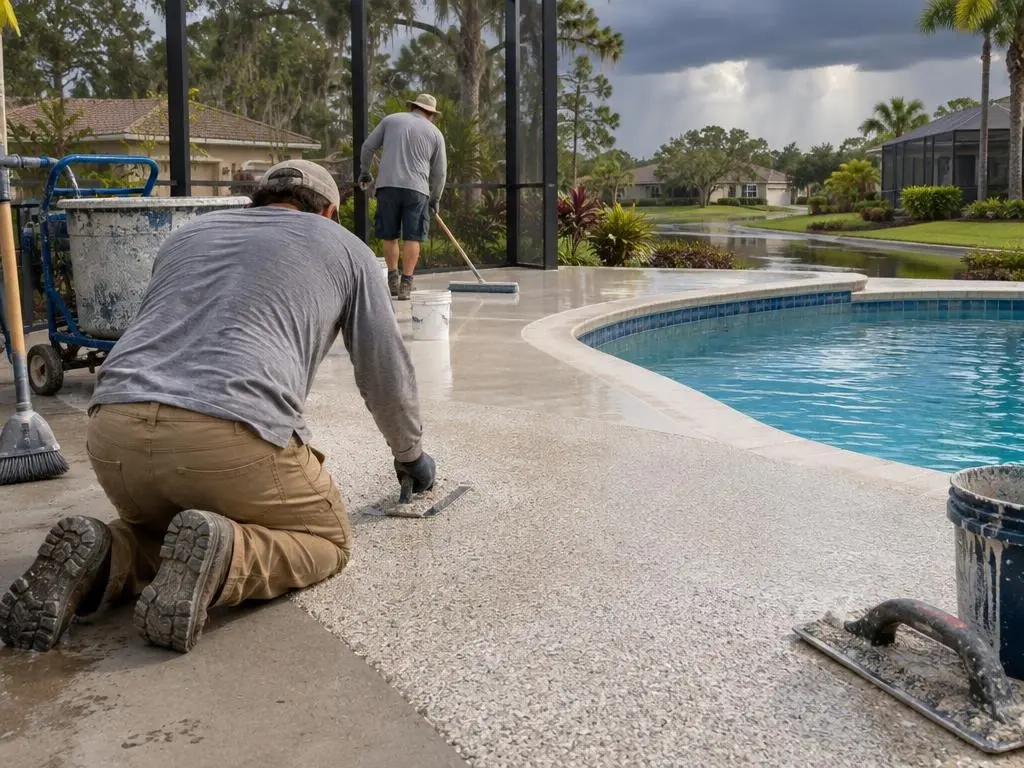
- Patios: backyard slabs, patio extensions and screened porch floors
- Decorative concrete: stamped and colored finishes for patios and walks
- Walks and steps: front walks, side paths, stoops and porch steps
- Slabs: garage, shed, carport and equipment pads
- Repair and replacement: root-heaved sections, sunken corners, trip edges and failed steps
We work in every part of the city, from the student rentals around campus to the neighborhoods off Millhopper Road, Archer Road and Tower Road. Call (352) 558-2464 to set up a visit.
Gainesville Facts That Shape a Concrete Job
- Tree canopy. Gainesville has been a Tree City USA every year since 1982, and a 2016 study found canopy over 47 percent of its land.
- Duckpond district. The Northeast Gainesville Residential District was listed on the National Register in 1980 with 229 historic buildings.
- Rainfall. The city averages 48.31 inches of rain a year, with about 15 nights at or below freezing.
- Driveway permits. The city issues driveway permits through its Building Inspection Department; right-of-way digging needs a separate Public Works permit.
- Sinkhole ground. Alachua County says sinkholes are most common in the western and central county, where limestone has thin sand cover.
Gainesville Questions
Do I need a permit to replace a driveway in Gainesville?
Yes. The City of Gainesville lists driveway installation as work that needs a permit from its Building Inspection Department. If the job reaches the apron or public sidewalk, a Public Works right-of-way permit and final inspection may also apply. We confirm the permits before scheduling.
A tree root lifted my walk. Can you fix it without killing the tree?
Usually, yes. We can reroute the walk, change the joint layout or rebuild the base so the new section has room. We do not cut major roots without your go-ahead, and for a large or protected tree we suggest an arborist's opinion first.
Is the low spot in my patio a sinkhole?
Most low corners come from sand washing out from under the slab, often near a downspout. A sinkhole tends to open suddenly and keep growing. If we see signs of one, we will stop and recommend a geologist or engineer before any new concrete goes down.
Free Estimates in Gainesville, FL
Tell us your neighborhood and what the concrete is doing, and we will set up a free on-site estimate anywhere in Gainesville.
Concrete Contractors Near Gainesville
- Concrete Contractors in Alachua, FL
- Concrete Contractors in Newberry, FL
- Concrete Contractors in High Springs, FL
- Concrete Contractors in Archer, FL
- Concrete Contractors in Hawthorne, FL
- Concrete Contractors in Micanopy, FL
- Concrete Contractors in Waldo, FL
- Concrete Contractors in LaCrosse, FL
- Concrete Contractors in Haile Plantation, FL
- Concrete Contractors in Jonesville, FL
- Concrete Contractors in Melrose, FL
- Concrete Contractors in Williston, FL
- Concrete Contractors in Starke, FL
- Concrete Contractors in Keystone Heights, FL
- Concrete Contractors in Cross Creek, FL
- Concrete Contractors in Trenton, FL
- Concrete Contractors in Bronson, FL
- Concrete Contractors in McIntosh, FL
- Concrete Contractors in Fort White, FL
- Concrete Contractors in Evinston, FL
- Concrete Contractors in Bell, FL
- Concrete Contractors in Brooker, FL
- Concrete Contractors in Hampton, FL